Saturday, March 24, 2012

Your True Colors

Cyndi Lauper has always been one of my favorite musical artists.  She co-wrote and performed some beautiful music, including Time After Time, which includes a lot of metaphorical lyrics that I find interesting.

One of the things I like best about her, along with her music, is that she always made a point of letting her Freak Flag fly; in fact, the name of her 1983 debut album was She's So Unusual.  She definitely lived up to that description in her dress, hair styles, the way she danced, just everything about her.   I used to think it was probably mostly a gimmick designed to set her apart from the hundreds other would-be pop stars of the 1980s. I don't believe that any more.

The reason for my change in attitude about Cyndi's odd-ball persona, is because I have really listened to and thought about another of her songs, True Colors.  In this song, Cyndi is talking to someone she loves who is feeling sad.  She attributes her friend's feelings to a "world full of people" that make him lose sight of himself, causing the darkness inside of him to grow and make him feel small.   The chorus of the song is the advice she offers him:

"But I see your true colors
Shining through
I see your true colors
And that's why I love you
So don't be afraid to let them show
Your true colors
True colors are beautiful,
Like a rainbow"

She tells him that she can see the real him underneath the darkness, and his "true colors" are the reason she loves him.  Think about that.  She knows who he really is  -- not the person he might think he should be, or the person the world expects him to be, but the real him.  And she tells him not to be afraid to be who he really is, that that person is beautiful.  In the video linked above, she is living out the advice she gives in the ultra-strange ways she dresses,  the way she moves, and the way she wears her hair.  Parts of the video include settings that look like they might be out of a Dr Seuss picture-book.   It's as if she's saying to everyone, "Look at me.  I'm unusual, but I'm OK with it.  If I can look and act the way I do, what's to stop you from being who you really are?"

There are a lot of reasons that this advice might be hard for people to follow.  The "world full of people" that Cyndi's song refers puts all kinds of expectations on each of us.  As children, we are taught how we "should" be according to our gender, our socio-economic status, our race, ethnic background,  and a thousand other things.  Parents, schools, and churches impress on us their desires and expectations for who we should be and how we should act.  Advertisers make sure we are fully aware of the ways we fall short in appearance and physique.  It is easy to be inclined to try to hide, or even to deny our "true colors,"  the people we really are.  Letting those true colors show can be frightening and make us feel vulnerable.

Recently I have been reading Being Jesus in Nashville, the controversial new book by author Jim Palmer, who also wrote Divine Nobodies and Wide Open Spaces.  In his new book, Jim continues his journey of shedding religion to find Jesus,  He challenges himself to live a year exploring what it means "be Jesus" in his hometown of Nashville.  In other words, Jim seeks to interact with the people he encounters the way Jesus would have.  Pretty radical stuff.

One of the chapters of this book is titled "Being Jesus Means...Seeing People As They Truly Are."  In this chapter, he tells of his developing friendship with a homeless woman named Pattie he meets outside Panera Bread.  Their friendship grows, and eventually Pattie tells him, "Jim, I don't know if you will understand this, but when we are together I don't feel like a 'homeless person.'  I just feel like Pattie -- and that makes all the difference."

Jim relates his experience with Pattie to Jesus' encounter with the Samaritan woman at the well.  Jesus interacts with the woman just as the individual she is, not as a Samaritan, or a woman, or a sinner. He sees all those things about her, her true colors, but he doesn't hold back from their encounter.  He offers her "living water."  He sees her as she is, and he loves her anyway.  I believe that, as Cyndi Lauper says to her friend in her song, Jesus loves the woman at the well because she is the the exact individual that she is.  He didn't ask her to clean up her act first; he didn't weigh her down with heavy obligations.  He told her that  "God is spirit, and his worshipers must worship in the Spirit and in truth."

"In truth."  I believe that means we must seek the truth about God, but it also means we must seek and embrace the truth about ourselves.  He already knows who we are, and he us loves anyway.  He loves us because of who we are.  If we can be real with God, if Jesus really knows us, then why should we be afraid to be who we are?  Why shouldn't we let our true colors come shining through?

"One of the greatest moments in anybody's developing experience is when he no longer tries to hide from himself but determines to get acquainted with himself as he really is."  —Norman Vincent Peale

Tuesday, March 20, 2012

Patsy, Trisha, and the Power of Music


Early one morning as I was driving downtown, I was listening to a classic country radio station.  I heard an old song that I remember from my childhood, Patsy Cline’s “She’s Got You.”  According to Wikipedia, Patsy recorded it in 1961, the year I turned 5.  I have a very vivid memory of being at our little house on 38th Place in Lawton, playing with my sister in our parents’ bedroom, for some reason.  The radio was on, and Patsy came on  singing the saddest song I had ever heard.  Even then I knew that she sang like an angel.   I listened attentively to the story she told, a story of lost love and regret, and I remember that it evoked images that I could relate to, such as a class ring and records, like my mother had, and other things I was too young to understand.  
At the time, my Dad was stationed in Korea, so I understood something about the feelings of loss the song expresses.  Every time I hear “She’s Got You,” I go back to that little house and remember vividly what it was like to be a 5-year-old boy and all the feelings I felt the first time I heard it.   ­­­­­­

I have a playlist on my iPod titled "Patsy and Trisha."  The Trisha is Trisha Yearwood, in case you aren’t familiar with her.  These two are connected in my mind for several reasons.   They are both altos, and both have the ability to sing a song in a way that really moves me.  Trisha has a song called “Xs and Os” that includes the line, “Well she's got her God, and she's got good wine, Aretha Franklin, and Patsy Cline.”  So, Trisha and I share a love for Patsy’s songs.

Also, I once met Trisha Yearwood.  Well, kind of.  Back about 1998, I took my daughter and a friend of hers to the Independence Day concert at Ft. Sill, which was outdoors on the Polo Field.  The concert  was all country that year, and there was some young cowboy the girls wanted to see, I don’t even remember who.  The headliner was Willie Nelson, but there were several other artists, and there was Trisha, who was the reason I wanted to see that concert.   I remember that when she took the stage, I pushed my way closer to the front so I could see her better.  She was singing something angelic and I was mesmerized.   As I stood there smiling, a little taller than most in the crowd, wearing my OU Sooners ball cap, Trisha looked directly at me.  I mean, we made eye contact.   She recognized me as an individual in the crowd.  There was a momentary connection between us.  For a few seconds, she was singing to me. It was not my imagination, really.  It happened. 

So, now when I hear Trisha, I remember that concert, the sounds of that day, the heat, and how cool it was to “meet” Trisha.  As when I hear Patsy Cline, Trisha’s singing takes me back to a specific place and time in my life.  

It is my experience that some songs have that power-- the ability to transport us, to remind of the way we once felt, and how it was to be that younger version of ourselves.  I bet you have your own examples, just as I do.

Along with Patsy's and Trisha's songs, there are many others that transport me back.  When I hear Gladys Knight sing "You're the Best Thing That Ever Happened to Me," I think back to when Dana and I were first dating.  It was the first of many songs that we now consider to be Our Songs.  And when I hear Edwin Starr's War, I am once again a junior-high kid, having a great time roller-skating as fast as I can at the Doe Doe Park rink.  

I think Trisha could relate to all these musings because she has another song called “The Song Remembers When.”  It is one of the most beautiful songs I have ever heard.  If you have never heard that song, or even if you have, take just a few minutes and experience it here.    This song is another one about lost love, about a song on the radio bringing back memories and feelings long buried:

"After taking every detour
Getting lost and losing track
So that even if I wanted
I could not find my way back
After driving out the memory
Of the way things might have been
After I'd forgotten all about us
The song remembers when."

Those lyrics express beautifully one of my favorite aspects of music.  If you listen to Oldies Radio, like I do, assuming that you are old enough to remember when those old songs were new, you know what I am talking about.  Who needs a time machine?  The songs remember when.


Saturday, March 17, 2012

(**)It Happens.....

 This afternoon, I started down the street for a walk, going east on our street on my regular route.  I thought I'd take advantage of the beautiful weather and maybe work off a little of that big lunch I had eaten earlier.  It was 75 degrees here today and cloudy, so it was perfect for such an excursion.   I was walking along past a house I've passed a thousand times when I noticed something I hadn't seen before.

There was a sign on the house's fence.  It said, "IF YOUR DOG POOPS PLEASE SCOOP."

Well, I laughed out loud.  For one thing, it was so totally unexpected.  When I first spotted the sign, I couldn't tell what it said, so I figured it was probably "BEWARE OF DOG"  or something like that.  But, no, this message was completely different.  I appreciated the little hint of humor, sort of a limerick with a message, since it kind of rhymes.  Also, ever the grammarian, I was glad to see there weren't any superfluous apostrophes, as in "IF YOUR DOG POOP'S PLEASE SCOOP."  That would have ruined it for me.  (Personally, I would have added a comma after "POOPS"  but I recognize that a comma is optional in this case and may have incurred an extra expense with the sign-maker. )

But more than that, the message on the sign immediately struck me as a metaphor for lots of interactions between people.   We often use "poop," or something more graphic (think Bovine Scatology), to represent negative stuff in our lives.   If you remember in the movie Forrest Gump, when Forrest was on his long run, some reporter asked him what he thought about something negative that had happened to him.  Forrest replied in his own distinctive intonation, "It happens."

It happens.  Poop happens. Sometimes there is dog poop in your yard.  Sometimes for real, and sometimes only metaphorically.

Sometimes the dog poop (either real or metaphorical) in your yard is just there, and there is no one you can blame for it.  As Forrest said, it just happens.  This might be because a band of wild dingoes (either real or metaphorical) invaded your neighborhood and chose your yard as a substitute for a Porta-Potty.  Or maybe there was a bad storm and a tree fell on your house.  Who you gonna blame, the tree?

Other times, there is someone to blame. Those you can blame come in two types.  (I have thought a lot about this, so you can trust me on it.)

One of the reasons that sign on the fence made me laugh is because it reminded me of (literal) dog-poop issues I experience at our previous house, which had a large corner lot with lots of space for neighborhood dogs to leave little presents for me to clean up.  Lots of little presents.  Some not so little.  So when I saw that sign, I immediately commiserated with the owner of that house.  I also wished that I had handled those issues more like he did, with a gentle reminder and a little humor.  More often I just fumed and raged.

As I said, our previous home had a large lot.  There was a long stretch of it that ran perpendicular to the front of the house and included one side of the privacy fence that surrounded our backyard.  From part of this stretch you could not even see the front of the house, and I could not see people allowing their dogs to fertilize it for me.   I knew they did, though, because I spent lots of time cleaning that stuff up.

One day, as I was driving home, I caught one of them in the act.  A lady I did not know, but whom I had seen around the neighborhood walking her little Yorkie (or some such critter), was standing and watching her doggie do his business on that stretch of my yard.   I slowed down, rolled down my car window, and as calmly as I could, said, "That is my yard.  You are using my yard as a dog-run.  I'm going to have to clean that up."

Well, this lady was immediately mortified.  She looked at my house, where I had pointed, and I could see that she had never even thought that this piece of ground that her dog was defiling belonged to somebody.  She sputtered sincere apologies.  She promised that she would send her husband down to "clean up this mess," and that it would never happen again.

I was really glad that I had not been rude to that lady.   She was a nice lady.  She was one of the first type of people who bring poop into your yard, or into your life.  These people do not mean to harm, they don't realize they are hurting anybody.   They are in their own little world and they just don't think about how what their actions affect you.  If I had had a "POOP, PLEASE SCOOP" sign like my current neighbor down the street, this lady would have  adhered to it.  As a matter of fact, her husband did come and clean up after the Yorkie (I guess he was in charge of such things in their household), and she went so far as to leave a note in our mailbox apologizing in writing.   I always waved to her when I saw her after that.

Another battle in the Poop Wars I fought at that house involved a representative of the other type of people who bring crap into your life.   There was another dog-walking woman in our neighborhood, whom I had observed more than once allowing her monster-dog to drop big steaming piles in other people's yards. In their front yards.  This woman could not claim ignorance like the lady with the Yorkie. Oh, no.  She was brazen.  She marched her dog around the neighborhood, letting crap drop where it would and never stooping to scoop.  She, like others of her type, know what they are doing to you and they just don't care.

I am a little ashamed (and a little proud) to describe what I did the day I found one of her brute's mounds in my front yard by the mailbox.  I got in my car and drove around the neighborhood until I found her and her beast, and I confronted her.  I told her I knew what she and her dog had done, and that the next time it happened I would shovel that stuff up and deposit it on her front porch.  She tried to deny the dirty deed, but I told her that I had examined just such a pile I had seen her dog deposit in my next-door neighbor's yard, and I knew that brand of doggie-doo when I saw it.  She never admitted anything, or apologized, but I didn't receive any more of those packages from Brutus.  (She also didn't know that I had no clue where she lived.)

So, anyway, that sign I saw this afternoon on my neighbor's fence reminded me of the Poop Wars, and it reminded me that sometimes people mess you over without meaning to.  I think it is best to give them the benefit of the doubt whenever you can.  Sometimes that idiot that pulls out in front of you in traffic just didn't see you, or is preoccupied with something.   I believe that most people are like the lady with the Yorkie, rather than that other woman.  And although I accomplished what I set out to when I confronted the crap-on-your-neighbor woman, I paid an emotional price by getting a bit overwrought.  It is better, whenever possible, to just remember that "it happens" and try to keep smiling.

Sunday, February 5, 2012

A Fouse by Any Other Name....

This summary is not available. Please click here to view the post.

Saturday, January 14, 2012

Important Stuff I've Learned

Today, January 14,  is my birthday.  This year it falls on Saturday, which is the day of the week on which I was born.  This coincidence led me to discover that the calendars for 1956 and 2012 are the same. In other words,  every date in 2012 will be on the same day of the week as it was in 1956.  (This is not all that unusual an occurrence.  It also happened in 1984, the year my daughter was born.) Also, I was born in '56, and this year I am turning 56.  I wonder what cosmic significance that little co-inky-dink holds?   Probably nothing more than the fact that I am approaching decrepitude.  However, I think the coincidences are interesting, and sometimes they really  do mean something.....

I have heard it said that Time is the great thief.  When I look in the mirror, I notice a few things it has stolen from me. It would be easy to bemoan the parts of myself that are not quite like they used to be, and  like I wish they still were.  I often think of people I have loved that I won't see again this side of Heaven.  Time took them from me.  Those little children of mine are grown into a wonderful young man and woman with children of their own, but sometimes I get nostalgic for the days when I was the most important man in their lives, before Time moved us all into different stages of life.  So, I agree that Time has stolen things from me that I loved.  However, I also know that I traded the joys of my younger days for new joys, and for some insights that I didn't have back then, for lessons that Life has taught me, sometimes through hard times I would rather have gone around than through.  I'd like to share a few of those lessons.

It is important to learn to accept ourselves, to embrace who we are.  There are lots of things in life that seem to conspire to make doing this difficult.  Sometimes parents, schools, and religious institutions cause us as children to focus on the things about ourselves that are less than perfect.  Advertising today certainly makes it difficult for anyone who has ever been near a TV, a magazine, or the internet to feel good about the way they look.  Often, we see others and think they are closer to what we should be, smarter, better looking, or more successful.  Pardon me for saying so, but all this kind of thinking is just bullshit.  You are who God made you  to be. You have been shaped by your environment and your heredity. It doesn't change anything to hold yourself in low esteem, or to try to be something you aren't.  Jesus said we are to love our neighbors as ourselves. That implies we are to love ourselves.  This does not imply that we aren't to try to better ourselves when possible, to achieve all we can.  But despising and belittling ourselves doesn't change who we are.  Approaching life from a position of self-love empowers us to be who we were meant to be.  There is only one of each of us.  We should all be radically ourselves.

It is important to accept other people as they are.  This is sort of a corollary of accepting ourselves.  In fact, I believe that if we don't first accept ourselves, we probably won't do such a great job accepting others.  There will always be people in life that annoy, irritate, or  even enrage us.  There will be people who stand for things we oppose, people who believe in things we abhor, people who hurt us time and again.  I believe it is in our own best interest to accept people as they are.  This doesn't mean that we shouldn't sometimes suggest to people important to us things they could improve about themselves, or ways they could change to make our peaceful co-existence more easily attained.  It does mean, however, that people are who God made them to be, just like we are who he made us to be.  Hating someone for who they are or how they live does not change them.  Refusing to forgive someone who has hurt you does not change them.  Indeed, carrying all those negative feelings around hurts us more than those they are directed to.  Remember what Jesus said about loving our neighbor?  Spreading around God's grace freely is very liberating.  I recommend it highly.

It is important to laugh -- often.  
This is an important lesson to learn.  I believe that God gave us laughter to help us deal with the stress and strain of everyday living.  You can worry and fret your way through life, but what good does that do?  What does it change?  Nothing.  If you can find a way to laugh every day, several times each day, you can more effectively deal with the things you have to cope with.    As e e cummings said,  "The most wasted of all days is one without laughter." There are all kinds of medical benefits that laughter provides us.  The other day at work, we were having a typically stress-filled day, and somehow several of us began joking around, and soon we were all laughing, and dealing more effectively with what we had to do that day.  Someone a few rows over in the cubicle jungle later told me that she didn't hear the jokes, but she heard what she called "joyous laughter," and her spirits were lifted too.  And have you ever noticed that if there is a strained relationship  between you and another person, laughing together seems to remove the tension?  It's miraculous.  My advice is to laugh often and laugh loudly. As the Eagles sang, "Lighten up while you still can "

So, if I could travel back in time, say to January 14, 1977, these are the things I would try to explain to the 21-year old Steve Fouse, because he did not know these things, and maybe he could have benefited from learning them sooner than I did.  There are other important things I have learned along the way, but a lot of them aren't very interesting, like, "the more you eat, the more you want," and "save early and save often," so I probably wouldn't bother him with those things.   It probably wouldn't matter anyway.  He'd probably have to learn his lessons the hard way, just like I did.  

Sunday, December 18, 2011

The Sound of Silence

This time of year we often hear the beautiful old song "Silent Night,"  which speaks of the "heavenly peace" of  the night when Jesus was born.  As the song continues, it tells of how the silence of that night is shattered, and the witnessing "shepherds quake at the sight" of  an angelic choir heralding the birth of Christ.  The silence of that night represents peace and calm, but the end of that silence is welcomed because it brings something better.
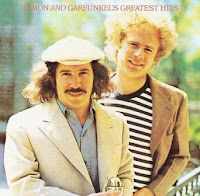
The classic rock duo Simon and Garfunkel are also famous for a song about silence.  However,  unlike "Silent Night," which uses silence as a metaphor for peace and well-being, "The Sound of Silence"  has a different message.  As Art Garfunkel says in the video linked above,  the song uses silence to symbolize people's individual inability to communicate with one another, and their failure to love one another.  The song uses stark images of a vision the narrator experiences, a vision of city streets, neon lights, and the sound of silence, which, for me, represents the results of love-term isolation:


"And in the naked light I saw
Ten thousand people, maybe more.

People talking without speaking,

People hearing without listening,
People writing songs that voices never share
And no one dared
Disturb the sound of silence."

People not communicating. People not relating to one another.  People ignoring one another.  People going through the motions of interacting without really knowing each other.  People not having the courage to end their isolation.  Although Paul Simon wrote "The Sound of Silence" in 1964, its message is perhaps more relevant than ever.  A 2009  article  from Psychology Today calls social isolation a modern plague:  "Remarkably, 25% of Americans have no meaningful social support at all - not a single person they can confide in. And over half of all Americans report having no close confidants or friends outside their immediate family. The situation today is much worse today than it was when similar data were gathered in 1985. (At that time, only 10% of Americans were completely alone)."  Consumer Reports from 2010 says that such isolation is not only bad for a person, but can actually shorten one's life.

To personalize this topic, I know that my wife Dana and I are somewhat isolated from people outside our extended family.  We work.  We come home.  We are tired.  We are both introverts and we tend to be a bit anti-social (keeping it real!), so we don't socialize much (except on Facebook).  Very little.  Hardly ever.  Most of the people in our neighborhood are just like us, so we haven't had much interaction with them, either.  For the most part, we have been fine with this state of things, each of us being content with the company of the other, occasional visits with our children and grandchildren, who live out of state, and  with my mother and Dana's brother and sister-in-law, who are local.  

Usually, Dana and I are fine with this arrangement. I sometimes wish we had a more active social life, but I haven't done  much to change it.  I just chock it up to people being busy and the state of our society.  Instead of front porches and "y'all come" attitudes, most folks today, including us, have patios out back with privacy  fences and  "please call first" attitudes.  When I was a kid growing up, we had stay-at-home moms and neighbors who knew one another and helped each other out.  Now many people value their privacy over a feeling of community.  When they aren't working, they mostly want to be left alone. They don't want to be bothered and they don't want to bother anyone else.  I am convinced we are paying a price for these attitudes.
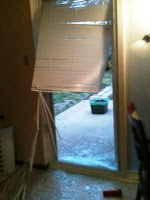
My attitude about how much community I need was changed drastically last Thanksgiving night.  Dana and I were at our daughter's house (380 miles from home), and, having enjoyed the holiday with her and her family, we were sleeping when my cell phone rang a little after midnight.   It was my home security company:  "Mr. Fouse, we have movement in your house."  They went on to inform me that the police were on their way.  I could not believe what I was hearing!  I reacted physically by beginning to shake.  I kept saying how cold I was, but Dana (an RN) later told me that I was experiencing a rush of adrenalin.  What do you do when there are thieves in your house and you are 5 hours away?  I eventually spoke to the policeman who was in my house responding to the call from the security company.  He told me that the burglars had thrown a rock through the glass patio door in our bedroom and entered there.  When I told him I was facing a long drive home, he asked me if I could call someone to secure my house.  That was an excellent question.  My mother was out of town for the holiday also, so I couldn't call her.  Being Mr. Independent, I hate to ask anybody for help.  But, in this case, I had no choice.  So, I called my neighbor Wayne.
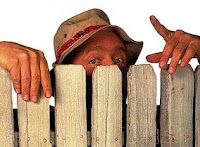
Wayne is my neighbor to the east, and he has always been a better neighbor to me than I have been to him.  He is retired and has lots of time to visit with neighbors.  He is friendly and outgoing, but not pushy.  Remember Tim Taylor's neighbor Wilson on Tool Time? That's my neighbor Wayne. Except that I have actually seen his face   He had offered to help with things around the house a few times, so I knew he was the one to call, as much as I hated to. I found his number on the internet and called his house. When he answered, I told him I was sorry to wake him, to bother him at that hour.  He said he didn't mind, that my alarm had awoken him earlier.  He told me he had been outside when the alarm went off, but he hadn't seen anyone.  There wasn't any way he could secure my house with a gaping hole in the door, but he promised to keep an eye on it until I could get home.  Talking to Wayne calmed me greatly.  Just knowing there was someone friendly here made the situation seem less dire.

Dana and I drove all night and made it home about 7:30 the next morning.  Not much was gone, but our sense of safety had been shattered along with that glass door.  When the police arrive later, Wayne talked to them, and commiserated with us.  Richard, my neighbor on the west, came out and said that he had also heard my alarm.  He helped the police locate some items that were stolen from my mailbox, items that the police used to try to get the culprits' fingerprints.  When I brought home the replacement door from Lowe's the men who live across the street helped me move it into the house.

Simon and Garfunkel have another song about isolation.  Long one of my favorites by them," I Am a Rock" is about the ultimate anti-social person, who proclaims, "I am a rock; I am an island.  I build walls, their fortress deep and mighty, that none may penetrate...."  Many people today, although they might not overtly express those ideas, live them out  in their lives.  I know that I have been prone to self-imposed isolation, although not to the extent of the Rock in the song.  Cutting yourself off from those around you becomes a habit, a way of living that is hard to overcome.  I have come to realize that, as "The Sound of Silence" puts it, "silence like a cancer grows."


‎"Silence propagates itself, and the longer talk has been suspended, the more difficult it is to find anything to say." -- Samuel Johnson

However, my experience with the burglary taught me some things relating to our places in society, and about myself.

First, whether we know it or not, we are part of a community.  My neighbors are part of my community, and I am part of theirs, even I don't know them well or rarely speak to them.  I know that  because I realized that morning when the police were at my house that Dana and I weren't the only victims of that burglary.  When my security was breached, theirs was also.  When my alarm sounded and woke them up, their silence, their peace was shattered, too.  Because if my house could be violated, theirs could too.  If hoodlums could destroy my property and steal my possessions, it could happen to them to.  Indeed, in a way, it did happen to them.
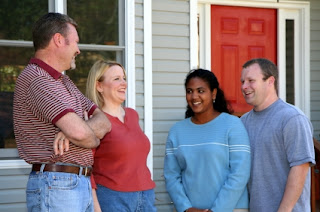
Secondly,  no matter how independent I prefer to be, I really do need people --  for practical things like helping me carry heavy objects, and for emotional support, like a friendly voice on the phone when I am facing a crisis.   Like it or not, I need other people, just like they need me.

So, what am I going to do about what I have learned?  I know that I am not going to become an extrovert, but I do intend to be more open to being in community with people, to whatever extent our relationship calls for.  I want to look for ways to be more sociable, to reach out to people.  Writing this blog has taught me that when I am honest about myself, even just in a blog, when I talk openly about things that matter to me, things that might make me feel vulnerable, I give other people permission to do the same.  I want to do that more in my  real-world interactions with people as well.

About a week after I was burglarized,  Wayne was out front when I came home from work.  He and I visited  on the curb for several minutes, talking about the burglary and about our families.  Before he left to go in, he told me that he would like to give me a key to his house, and to let me know when he was going to be out of town.  He asked me to watch his house during those times.  I told him I'd be glad to and asked him to do the same for me.  He said he'd be glad to.

I guess that's a start.

Saturday, December 3, 2011

Circles

 If you have wandered away from Facebook into that mysterious new world called Google+, you know that on that social network, instead of sending and accepting Friend requests as on Facebook, you add people to your Circles.  The people whom you add can add you to one of their Circles, or not, as they choose.  There are various pre-established Circles, such as Friends, Acquaintances, and Family.  Users can create and name whatever Circles suit their purposes.

Left-handed?  Who knows.....
So if you know a lot of people who are Left-Handed Cross-Dressers, you can create a Circle to group those people together. People being added to circles don't have to approve of your adding them (unlike accepting a Friend request on Facebook), and they are in fact unaware of what Circle you put them in.  Some of the Cross-Dressers you know might not be left-handed at all, they might be right-handed, or even ambidextrous, but you are making the Circles, so they don't get a chance to correct your mistaken ideas about them.    

Human interaction, both on the internet and in the real world, is so often about categorizing other people.   I suppose the most basic categories we all establish are Like Me/Not Like Me.  (Or maybe Acceptable/Unexceptable.) We all make judgments about other people based on all kinds of things, some of which are not very fair or accurate.  How often have you made a mental judgement about someone you just met based on how they look or what they are wearing?  If you are like me, it has been pretty often.  We do this without even thinking about it, sometimes without even realizing that we are doing it.  "Look at that person.  He/she is so (fill in the blank).   He/she is probably one of those people who (fill in the blank).  He/she (is, is not) someone like me.  Therefore, he/she (is/is not) acceptable." 

I learned a big lesson about myself a couple of years ago, when my wife and I were on an outing with our daughter Rachel and her son Ian, at an art museum in Oklahoma City, I think.  Ian was about 2 years old at the time, and we encountered a young woman in the museum who had a child about that same age.  I am ashamed to say that the young woman immediately fell into my "Not Like Me" category because she was extremely tattooed and pierced, much like the young man in the photo above, except that she was wearing a shirt.

I confess that it would never have occurred to me to speak to her, because her outward appearance said all kinds of negative things to me, based on my assumptions about people who adorn themselves that way.  So I was surprised when my daughter spoke to her, asking her her child's age, and generally engaging her in the kind of conversation young mothers often share about their children.  I was further surprised when the young woman seemed pretty much like Rachel in her demeanor, her love for her child, and the way she spoke.  It was clear to me that despite the way she looked, the young woman had more in common with Rachel than I would ever have imagined.  In fact, she seemed like a sweet person.  The fear and loathing her appearance has inspired in me disappeared.

 "Just because you are blind, and unable to see my beauty doesn't mean it does not exist. " -- Margaret Cho 


People my age remember very well the Civil Rights movement of the 1960s, and how African-American people struggled to gain rights and privileges afforded to other races in this country.  As children, we were taught that racial discrimination is wrong and destructive to those who are victims of it.  It is now unthinkable to me that I would despise someone based on that person's race.  If I ever find myself making assumptions about someone based on that person's race or ethnicity, I become aware of it and admonish myself to adjust my thinking.   In general, racial bigotry is now considered socially unacceptable, at least among the people I know.  However, unfortunately, other kinds of bigotry, categorizing of people, and "circle drawing" are still second-nature for lots of people today, engaged in  without their even noticing they are doing it.

The kind of thing I am talking about is based on people putting others into their "Unacceptable" category based on what those other people believe.   In our politically fractured society, it is common for politicians and everyday people to demonize those "on the other side of the aisle" because of their belief system.  This kind of thinking about "Outsiders" is also common among religious communities as well.  I was reminded of this yesterday when I read an interview with Jim Palmer, author of Divine Nobodies, Wide Open Spaces, and the upcoming Being Jesus in Nashville.  In his books, Jim writes about being a follower of Jesus outside traditional Christian institutions.   In  this interview, Jim talks about the his controversial upcoming book, in which he describes his experiment of attempting to be Jesus to the people he encounters.  The interview also discusses the fact that the content of that book  caused him to lose his contract with a major Christian book publisher, who deemed it too unorthodox.  

Jim also discusses his observations about how often people in religious communities indulge in the practice of excluding and demonizing other people:  "The hallmark of Christianity seems to have become who is excluded, which can include anything from a theological litmus test to what you wear to church on Sunday mornings. Since leaving institutional church and writing about my journey of shedding religion to find God, I have received hundreds of emails from other nobodies who feel judged and marginalized by Christianity, including Wanda the Waffle House waitress who’s only crime is having tattoos and wearing her Waffle House uniform to church, where people stare at her like she’s a whore and avoid talking to her after the service. "

How often do we exclude others, make them feel judged and marginalized, based on what they believe or how they look?  This happens in all areas of our society, not just churches.  Why do we do this?  What is it about people that makes us need to draw circles that include some, but exclude others?  I have thought a lot about those questions, and I have reached some conclusions about them.


First, it is natural, and not always destructive to make judgements about people and to categorize them.  On Google+, the purpose of the grouping people into Circles is to create sub-communities of people with something in common, so that that grouping can better enjoy their cyber-socializing.  In the real world, we do similar kinds of things through clubs and other kinds of organizations. Also, some of the judgments we make about people are useful, while others are not.   In the case of the young tattooed woman at the museum, it would have been logical for me to assume, based on her appearance, that she liked unconventional (to me) modes of self-adornment.  However, I made the mistake of assuming lots of things about her that may not have been true, and some that were definitely not true based on my daughter's conversation with her.  In short, I dehumanized her.  I made her one of them rather than the individual that she is.  I rejected her without knowing her.  As with the my imaginary Google+  Circle for Left-Handed Cross-Dressers, I did the categorizing, I made the decisions about her without her input, indeed without her knowledge.   


I believe that we often dismiss people, both within ourselves and through our actions towards them, in ways that diminish both them and ourselves.  I believe that this is contrary to what was taught by Jesus, who told us to love God first and to love others as we love ourselves.  I also believe that,  through this kind of thinking, we often cheat ourselves out of knowing someone different from ourselves, and from enriching our own experience by what we might learn from them.  I am proud that my daughter spoke to that young woman at the museum, and I am glad that I was there when she did. 

For me, Rachel was drawing the circle a bit bigger.  I hope to do the same. 

"He drew a circle that shut me out—
Heretic, rebel, a thing to flout. 
But Love and I had the wit to win:
We drew a circle that took him in!"
--Edwin Markham